
Main Sequence Ship Design Guide: Mass, Thrust and Power
Design ships in Main Sequence that fly: read mass and thrust, place reactors and manoeuvring thrusters, budget weapons, and test before you save a blueprint.
Main Sequence's ship designer is the feature that makes the game more than a factory builder. You place modules from the inside out, watch the mass and thrust numbers change, and end up with a hull that either flies like a fighter or wallows like a station.
The designer does not hide its math. It shows mass, hull, thrust, and dimensions in the bottom bar, and those four numbers tell you most of what you need to know before you undock. This guide explains how to read them and how to build a ship that does its job.
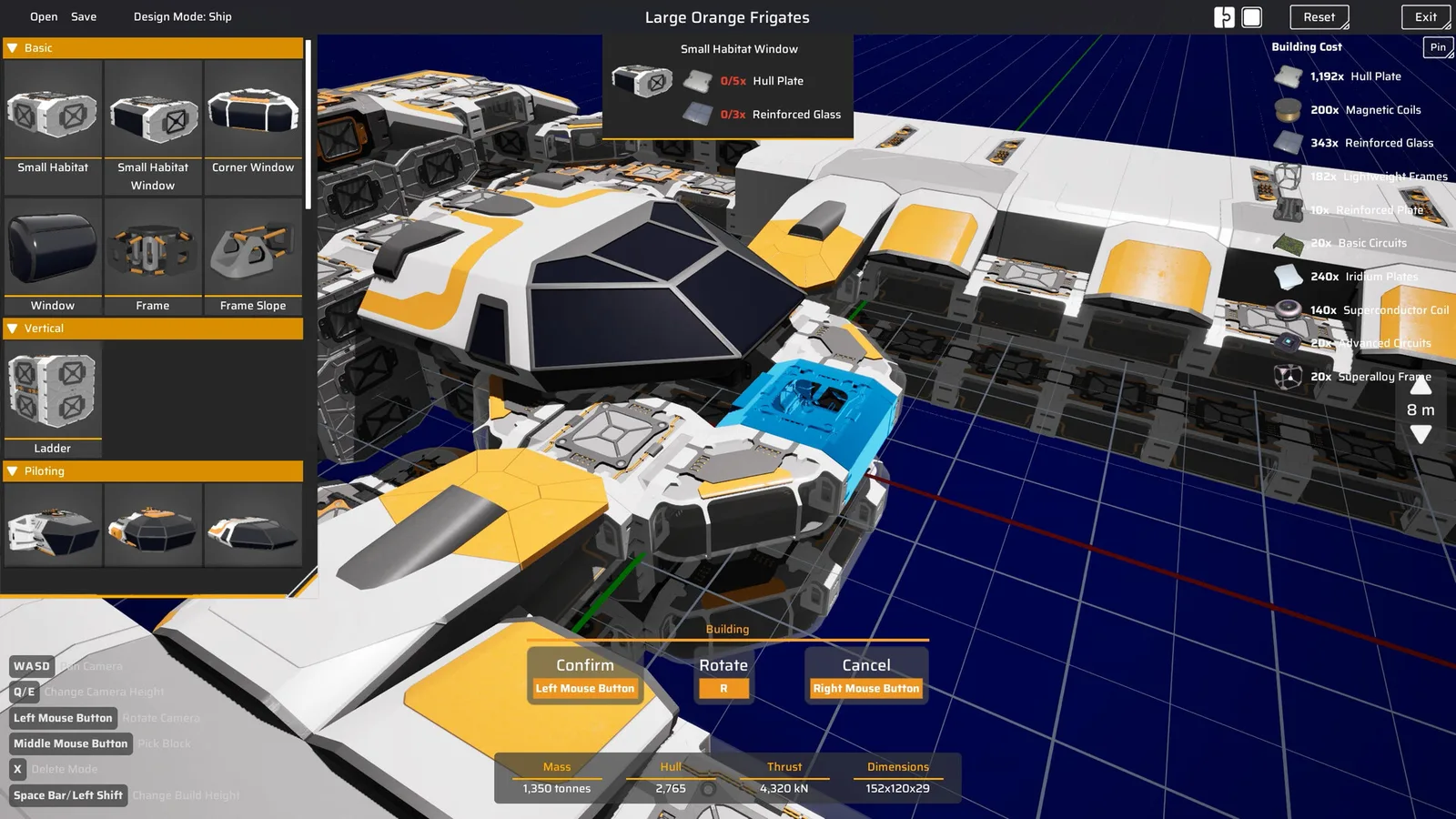
Aim for 2.5 to 4 kN of thrust per tonne on combat hulls and keep the reactor behind armour.
Where ship design happens
There are two entry points:
- Shipyard Design Console. The Shipyard Core contains a console that opens design mode for ships built at that yard. This is where you build new hulls and refit existing ones.
- Cockpit design access. Some ships expose a design interface from the cockpit, which is useful for quick refits but not a substitute for a yard.
A ship must be docked at a Shipyard to be modified. You cannot redesign a hull in deep space. Plan refits around yard visits, and keep a blueprint of the current design before you change it.
The four numbers
The design screen reports:
| Stat | What it means |
|---|---|
| Mass | Total weight in tonnes; drives acceleration and turn rate |
| Hull | Structural hit points; how much punishment the frame takes |
| Thrust | Total thrust in kN; drives acceleration |
| Dimensions | Bounding box in metres; affects hit profile and docking |
The store screenshots show the range. A “Large Orange Frigates” build reports 1,350 tonnes, 2,765 hull, 4,320 kN thrust, and 152×120×29 metres. A “Large Cruiser” build reports 462 tonnes, 785 hull, 280 kN thrust, and 88×56×16 metres. Those are player designs, not official classes, but the ratios are instructive: the frigate has about 3.2 kN per tonne, while the cruiser has 0.61 kN per tonne. The cruiser is either a station-support hull or an unfinished design; it will not dogfight.
A useful target for a combat ship is 2.5–4 kN per tonne. A miner or hauler can live with 1–2 kN per tonne because it does not need to turn tightly. A ship below 1 kN per tonne is a barge; it will drift and take forever to line up a mining laser.
Reactor first, then everything else
Every ship needs a reactor, and the reactor determines what else you can power. The Small Reactor produces 24 MW and costs 5 Hull Plates and 20 Magnetic Coils. Larger reactors exist for bigger hulls.
Add up the draw before you place weapons:
- Plasma Cannon: 3 MW recharge, 2 MJ per shot.
- Plasma Lance: 7.5 MW recharge, 10 MJ per shot.
- Shield Generator Mk.1: 3 MW.
- Small Thruster: 3 MW.
- Medium Thruster: 12 MW.
- Large Thruster: 48 MW.
Four Plasma Lances are 30 MW of recharge, which is already more than a Small Reactor before thrusters and shields. A warship with four lances needs a large reactor, not a small one with more capacitors.
The reactor's position matters for survival. Put it near the centre of mass, behind armour, and away from the nose. A reactor on the outer edge is the first thing a relic attacker hits.
Thrusters: placement beats count
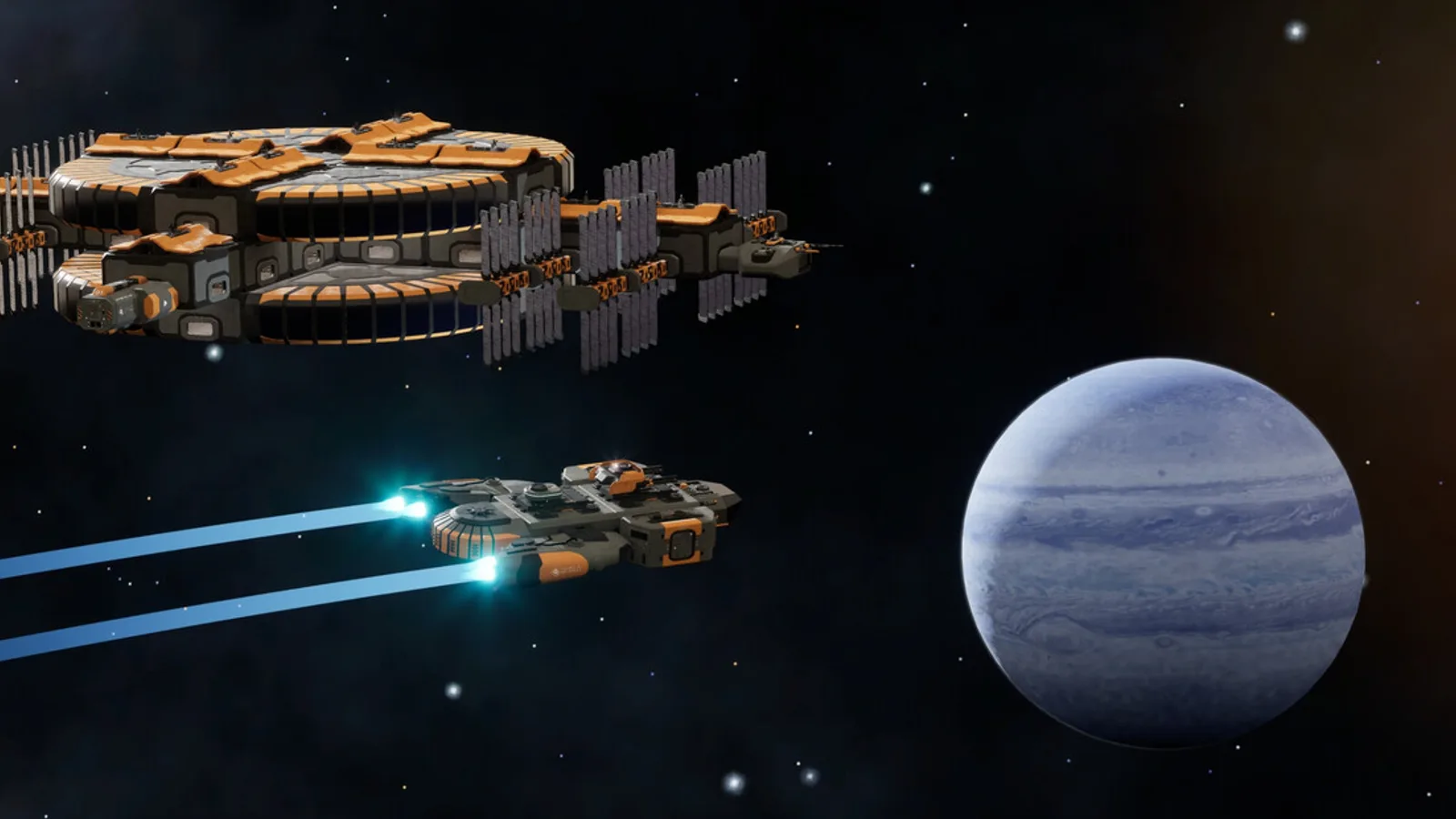
Thrust is a total, but turning is a geometry problem. A ship with all thrusters at the rear accelerates well and turns poorly. A ship with a manoeuvring thruster near the nose turns much faster for a small mass penalty.
A practical layout:
- Two main thrusters at the rear, symmetric around the centreline.
- One manoeuvring thruster on each side, forward of centre.
- One vertical thruster if the design allows it, for docking alignment.
- Keep the thruster exhaust clear of modules that would block it visually.
Symmetry is not just aesthetics. An asymmetric thrust layout induces drift, and the flight assist has to fight it constantly. Build symmetric, then offset cargo or weapons only where the mass difference is small.
Hull, armour, and cargo
Hull Plates are the structural material; Reinforced Plates and armour modules add protection at a mass cost. The design screen's hull number is your damage pool, not a armor rating. A high-hull ship with no armour still dies to focused fire.
Cargo capacity is a mass trade. A hauler with maximum containers will be slow and vulnerable; a combat ship with cargo pods is a compromise that does neither job well. Build specialised hulls:
- Miner: cargo for ore, one laser, one reactor, minimal armour.
- Hauler: maximum cargo, two thrusters, a shield if the route is dangerous.
- Combat: weapons, shield, armour, small cargo for loot.
- Explorer: detector, fuel, moderate cargo, speed.
The designer lets you save and share designs, so specialisation is cheap. You do not need one hull that does everything.
Weapons and hardpoints
Weapons are modules, not fixed hardpoints. You place them on the hull and they draw power and mass. The Plasma Cannon is the short-range workhorse at 600 metres; the Plasma Lance reaches 1,000 metres with much higher damage and draw. Missile Launchers and Point Defence Lasers are locked in the demo.
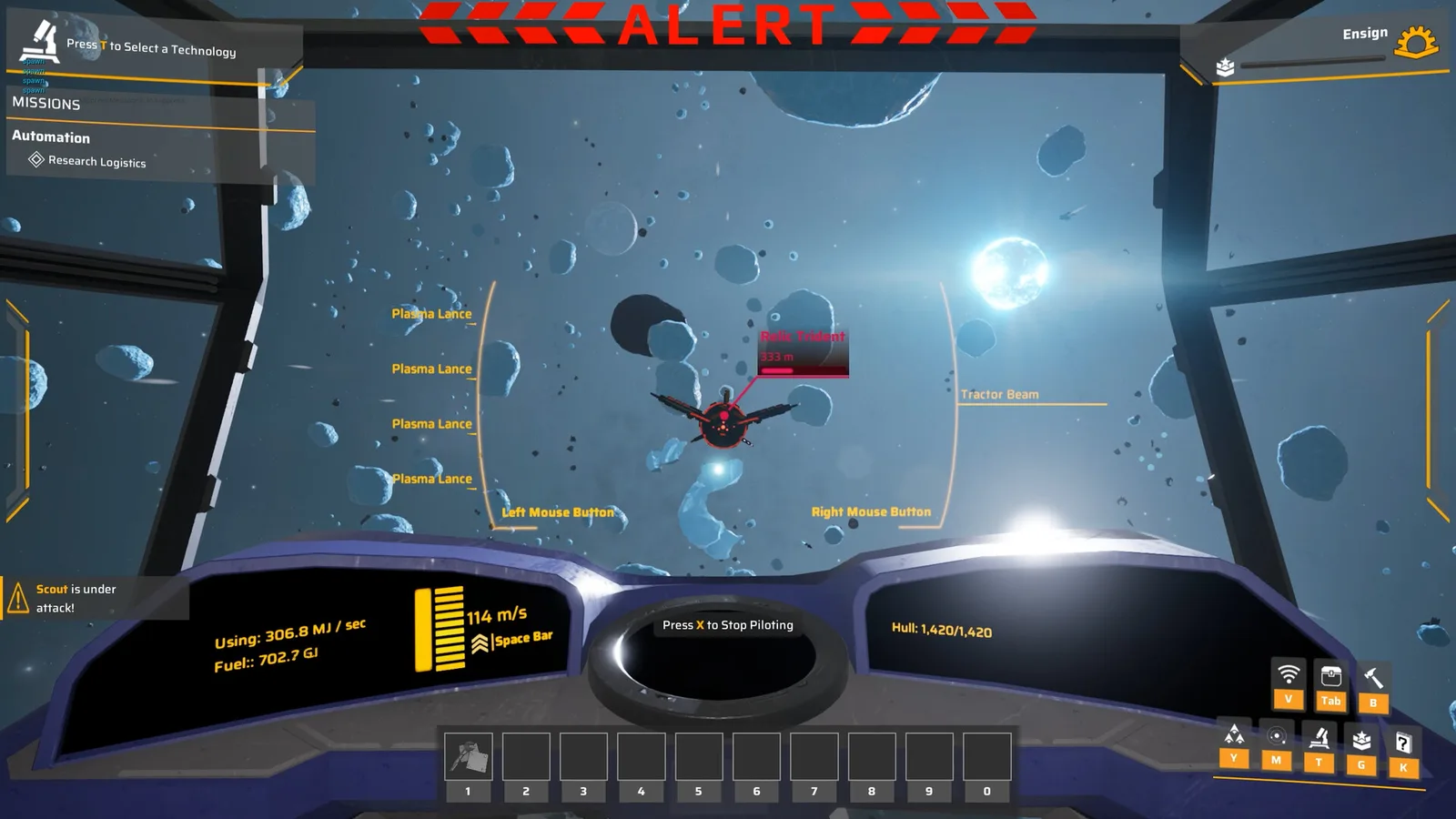
For a first combat ship, two Plasma Cannons and a Shield Generator are enough to kill relic scouts. For a relic destroyer, you need Plasma Lances and a plan. Do not build a broadside of weapons you cannot power; a ship that fires twice and then waits is worse than a ship that fires steadily.
Test before you commit
The designer shows stats, but it does not show handling. Build the hull, undock, and test:
- Accelerate to full speed and turn 180 degrees. How long does it take?
- Line up a mining laser on a small rock. Can you hold the beam?
- Fire all weapons while thrusting. Does the reactor keep up?
- Dock at the station. Does the hull fit the approach?
If the ship fails any of these, refit before you build a second one. A blueprint saved too early becomes a trap; save it after the test flight.
Ready to build a specific role? The ship builds guide→ has three loadouts.
FAQ
What is a good thrust-to-mass ratio? 2.5–4 kN per tonne for combat, 1–2 for miners and haulers.
Where should the reactor go? Near the centre of mass, behind armour, away from the nose.
Can I redesign a ship in flight? No. Dock at a Shipyard and use its Design Console.
Do weapons need power? Yes. Check the recharge draw before you add a third or fourth weapon.
Why does my ship drift when turning? Likely asymmetric thrust or too much mass at the nose. Add a forward manoeuvring thruster and balance the layout.
Official source: Main Sequence on Steam ↗ and the Steam news hub ↗.
Sources
- Main Sequence on Steam ↗ — modular ship design and module description.
- Steam news: Next Fest demo update ↗ — ship module changes.
- Main Sequence on SteamDB ↗ — build reference.
- Mythwright ↗ — publisher.