
Main Sequence Demo Guide: What You Can Try Before Launch
What the Main Sequence demo includes, which research tiers and hulls are unlocked, how co-op works, and whether demo progress carries into Early Access.
The Main Sequence demo is not a ten-minute teaser. It is a working slice of the factory game with mining, station construction, production chains, research, ship design, and co-op. That is enough to answer the only question that matters before 12 November: does this loop feel good to you?
This guide describes the demo as it stood in build 26097974, the version distributed during the October 2026 Next Fest. The launch build will add content and may change costs. Where the demo is explicit, the numbers below are exact; where it is silent, the guide says so rather than guessing.
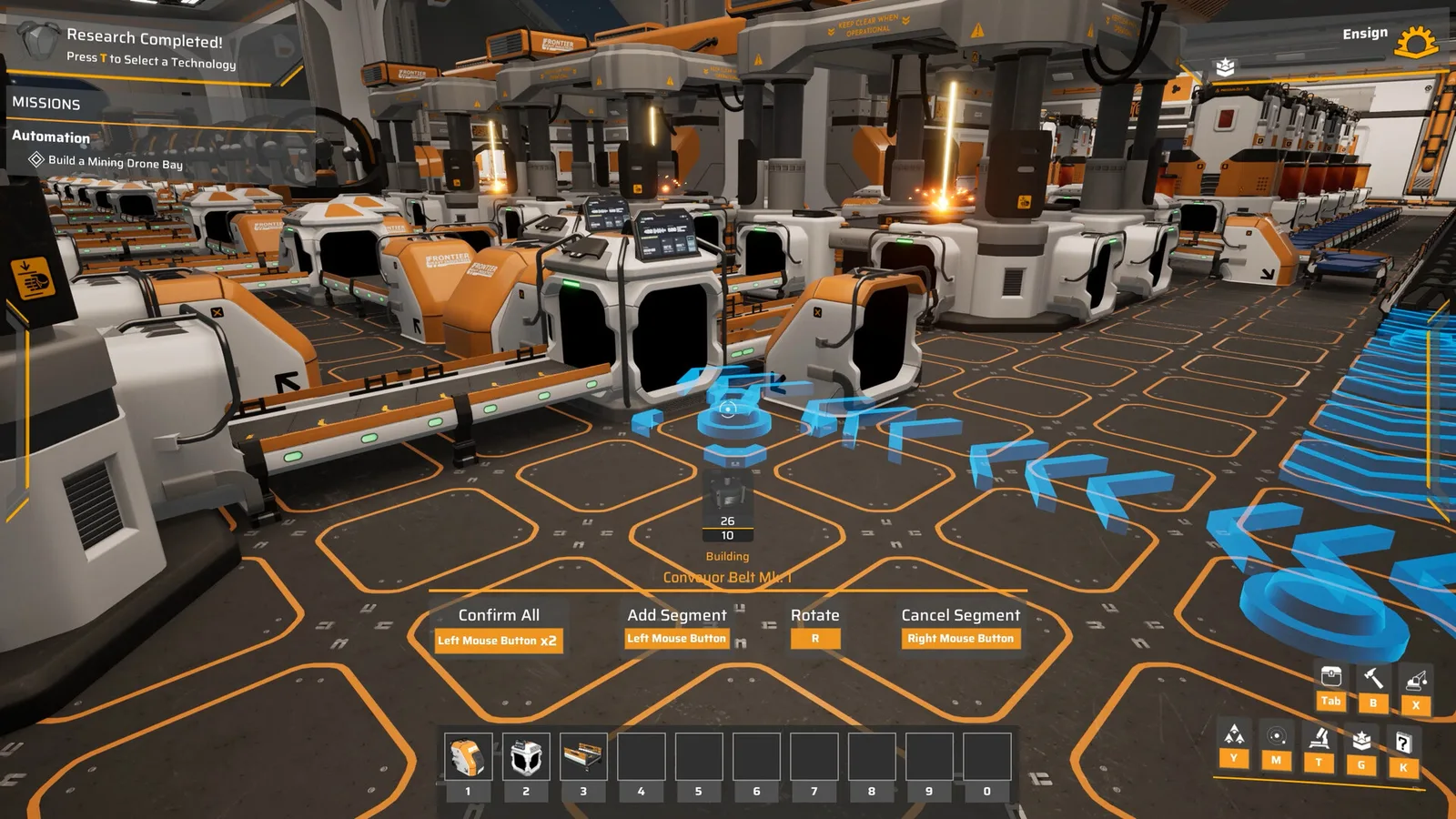
The demo caps out at tier 2: Slipstream Drive and Electromagnetic Science, with three hulls and co-op.
What the demo actually contains
The demo opens in a resource-rich asteroid belt with a small mining ship. You can scan, mine, refine, build a station, run production chains, research two tiers of technology, design and build ships, and play with other people. The save is local, and the demo is free.
The content boundaries are visible in the database:
| Category | Demo total | Locked in demo |
|---|---|---|
| Technologies | 97 | 43 |
| Items | 70 | 31 |
| Machines | 61 | — |
| Modules | 59 | 13 |
| Hulls | 3 | 0 |
Those numbers come from the demo's own data files, not from a press release. They explain why the demo feels complete: the core loop is all there, and the locks sit at the top of each progression line rather than in the middle of the opening.
The research ceiling is tier 2
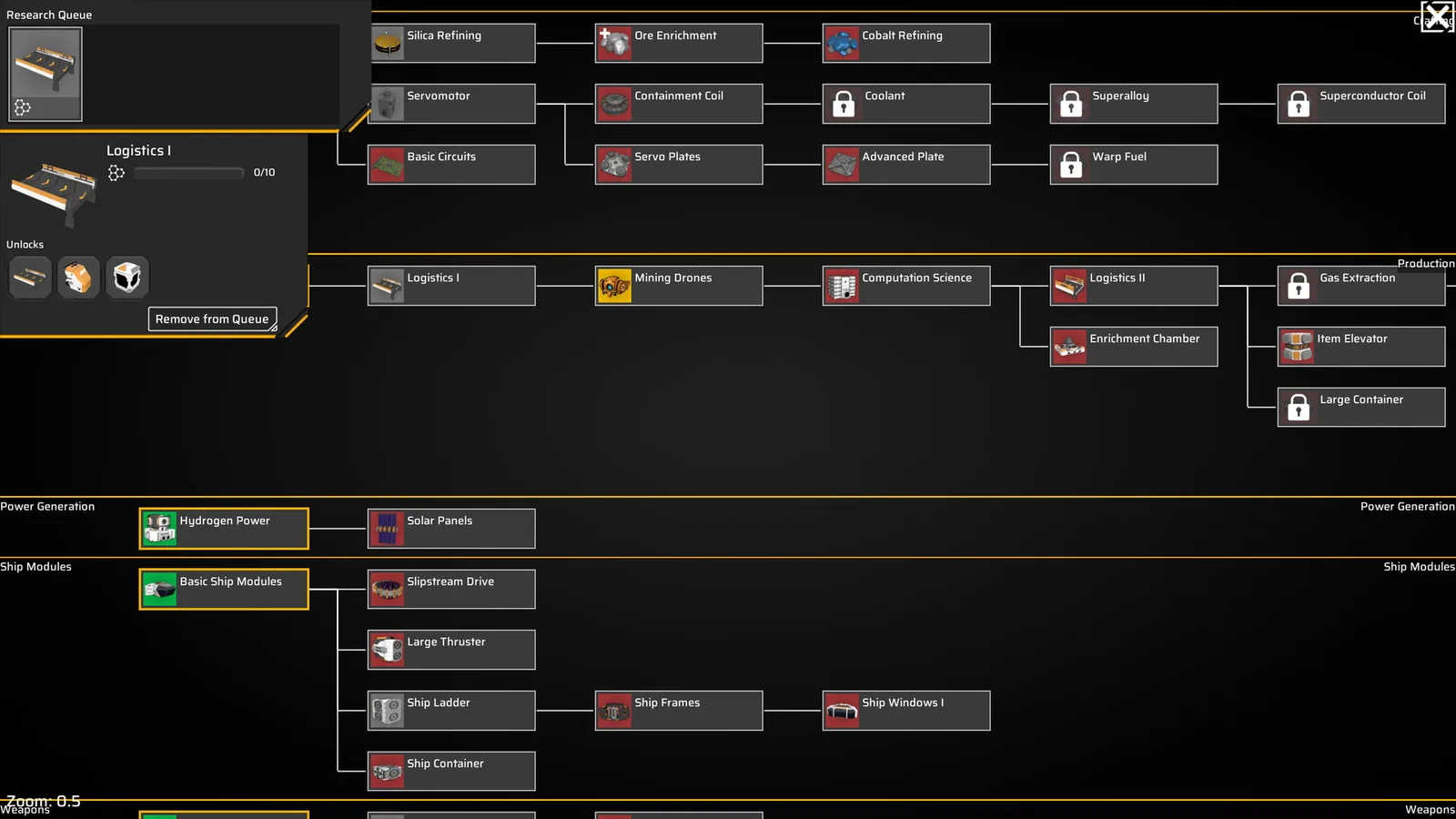
The demo lets you research through tier 2, which includes Basic Circuits, Computation Science, Shipyard, Logistics I, Servomotor, Mining Drones, Relic Analyzer, Slipstream Drive, Logistics II, and Detector Array. Tier 3 and above are visible but locked.
That ceiling is well chosen. Slipstream Drive is the first genuinely transformative unlock: it requires a Shipyard and an Enrichment Chamber, and it opens the warp-fuel recipe. You can feel the shape of the mid-game without being able to skip it.
The practical route through the demo is:
- Tier 0 free technologies to get refining and power running.
- Basic Circuits for the circuit line.
- Logistics I and Mining Drones for automated ore.
- Shipyard and Computation Science for ship production.
- Slipstream Drive and Enrichment Chamber for warp fuel.
- Logistics II and Detector Array if you want to push the demo's limits.
If you only have one evening, stop after step 4. The shipyard is the demo's best showcase, and it is where the design mode finally has a purpose.
Three hulls, no locked ship classes
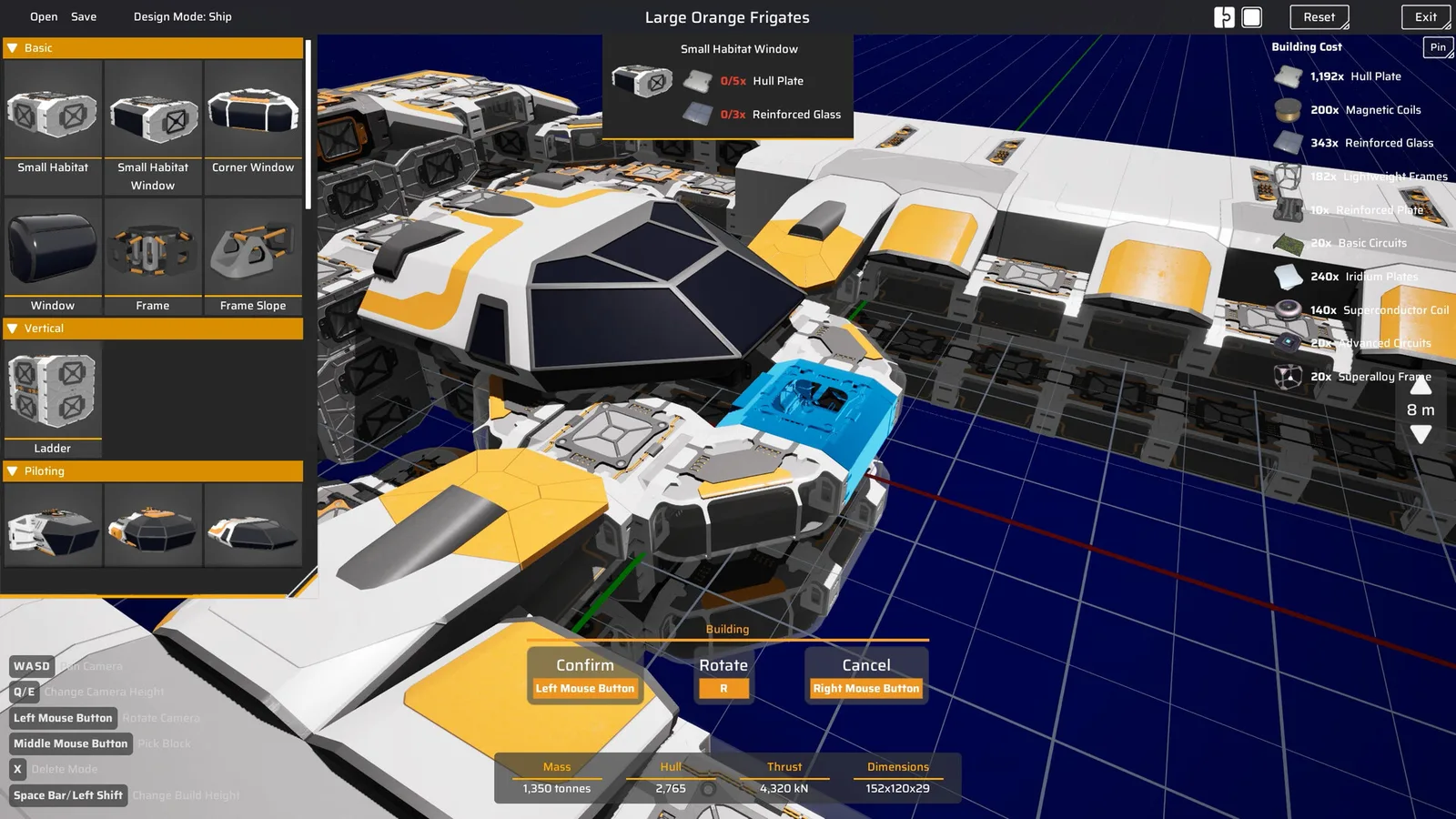
All three demo hulls are available: Scout, Prospector, and Gallant. The Scout is the cheap fast frame, the Prospector is the mining workhorse, and the Gallant is the combat-capable hull. You can build them at a Shipyard Core with side modules, then modify them at the shipyard's Design Console.
Ship design is the part that separates Main Sequence from a pure factory game. You place modules from the inside out: cockpit, reactor, thrusters, cargo, weapons, and hull. The design screen reports mass, hull, thrust, and dimensions, and those numbers matter. A 1,350-tonne frigate with 4,320 kN of thrust behaves very differently from a 462-tonne cruiser with 280 kN.
The demo does not include every weapon or defensive module, but it includes enough to make combat design meaningful: Plasma Cannon, Plasma Lance, Shield Generator Mk.1, and the station-side Plasma Turret. Missile Launchers and Point Defence Lasers are locked.
Co-op is in the demo
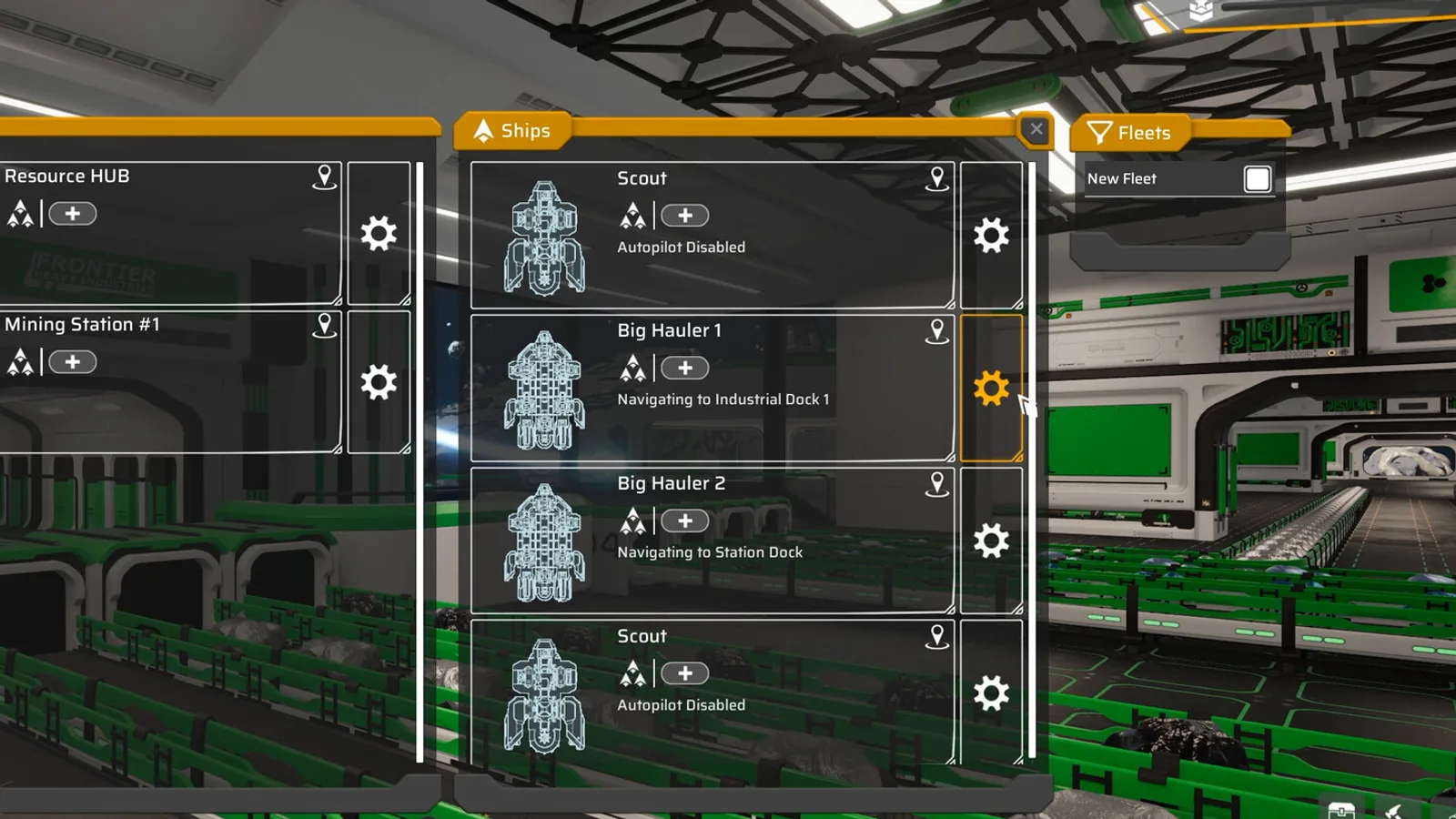
The demo supports online co-op and LAN co-op. Each player commands their own ship, and the group can split logistics, defence, and exploration. The Next Fest update added co-op to the demo explicitly, so it is not a launch-day promise.
Two caveats from the public build:
- Groups above three players report more latency and frame-rate loss. The demo is not a dedicated-server product.
- Joining is request-based: the host sees a join request and accepts it. There is no matchmaking browser.
If you want to test co-op before buying, the demo is the right place. It is also the best way to find out whether your group actually enjoys dividing factory labour, which is a different skill from playing solo.
What the demo does not tell you
The demo does not promise that saves carry into Early Access. The store page describes Early Access as a separate purchase and does not advertise save compatibility. Treat demo progress as disposable: use it to learn the systems, not to build a base you expect to keep.
The demo also does not include the full 1.0 roadmap. The Steam page says Early Access will last one to two years and that 1.0 will add more building options, customisation, quality-of-life features, new factions, new ship and station modules, new production lines, and more exploration locations. That is a direction, not a schedule.
Finally, the demo's performance is not a reliable benchmark for launch. Large stations and many drones are the heaviest load, and the launch build may optimise differently. If the demo runs at 30 fps on your machine, the full game will probably run similarly at launch, but do not buy on the assumption of a big optimization pass.
Should you play the demo before buying?
Yes, if any of these are true:
- You are new to factory games and want to know whether the 3D station building clicks.
- You care about ship design more than production ratios.
- You have a co-op group and need to test whether the roles are fun.
- You are unsure about the $24.99 price and want a direct comparison with Satisfactory or Factorio.
No, if you already know you will buy it. The demo's progression ceiling is low enough that a full evening will exhaust the interesting research, and starting over at launch is fine.
To see what carries into launch, read the release date and price guide→.
FAQ
Is the demo free? Yes. It is a free demo on Steam, not a time-limited trial.
Does the demo include multiplayer? Yes, online and LAN co-op, added in the October 2026 Next Fest update.
Can I keep my demo save? The store page does not promise save transfer. Plan to start fresh in Early Access.
How much content is in the demo? Roughly the first two research tiers, all three hulls, and the core factory loop. The demo data lists 43 of 97 technologies as locked.
Is the demo the same as Early Access? No. Early Access adds the remaining tiers, more modules, more exploration, and the 1.0 roadmap content over time.
If you are bringing friends into the demo, the Main Sequence co-op multiplayer guide→ explains role splits and shared storage.
Official source: Main Sequence on Steam ↗ and the Steam news hub ↗.
Sources
- Main Sequence on Steam ↗ — demo availability and Early Access description.
- Steam news: Next Fest demo update ↗ — co-op, world generation, and technology changes.
- Main Sequence on SteamDB ↗ — demo build 26097974 tracking.
- Main Sequence on the Epic Games Store ↗ — release date.