
Main Sequence Mining Guide: Laser, Drones and Beacons
How mining works in Main Sequence: scanner ranges, the 125m mining laser, drone bays, gas extractors, beacons, and a route that never runs dry.
Mining in Main Sequence is a range problem disguised as a resource problem. Every ore is available somewhere in the belt; the difficulty is getting your ship close enough, then getting the ore back to a refinery before you fall asleep. The tools are deliberately distinct: a short-range ship laser, a long-range drone bay, and a beacon that turns a ship into an autonomous miner.
This guide covers all three, with the demo's exact numbers and the routing rules that make them work together.
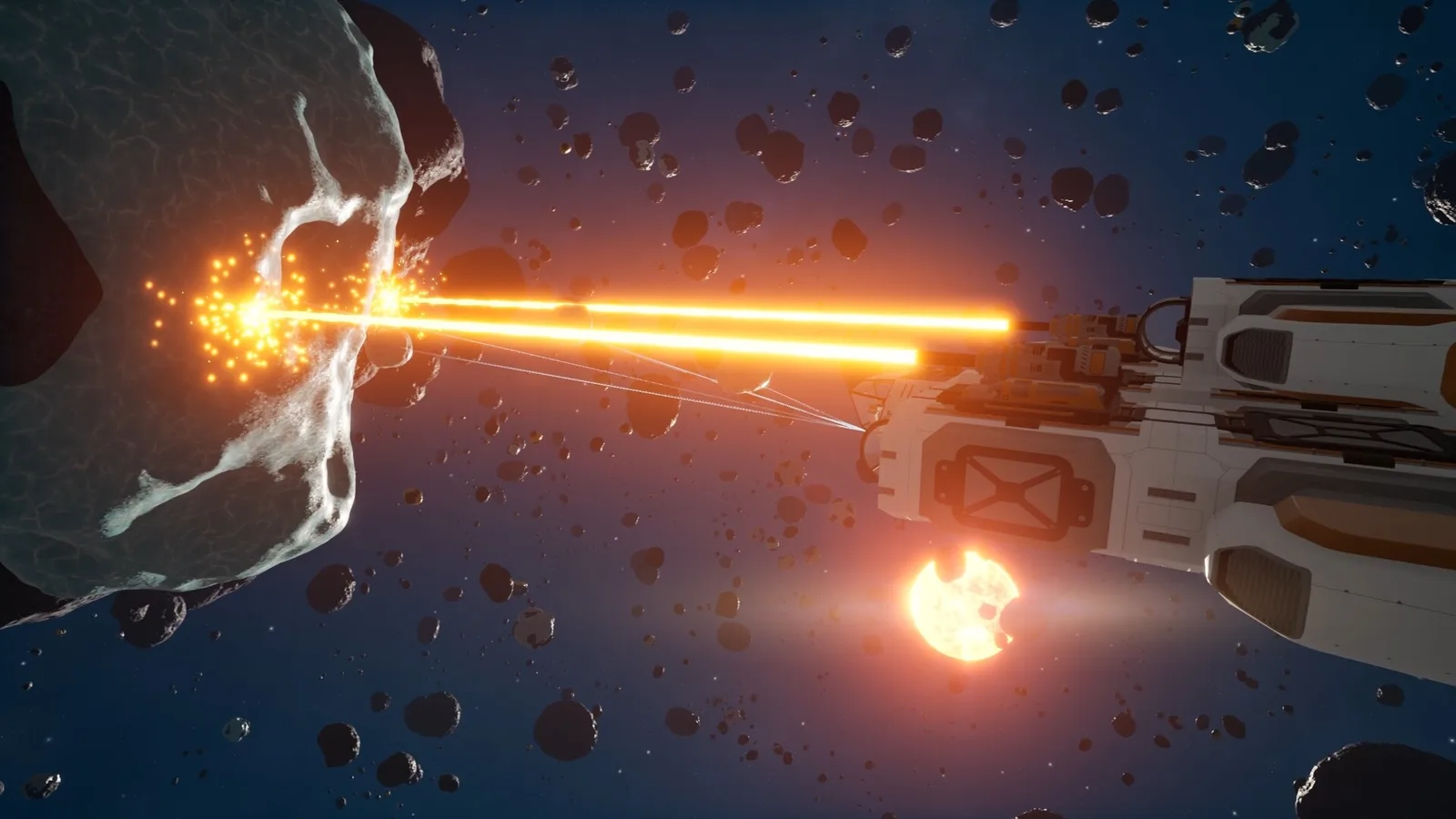
Use the ship laser at 125 m early, then add a Mining Drone Bay Mk.1 for 1,000 m passive collection.
Scanner first, laser second
The scanner is the only way to know what a rock contains before you commit. Ping the field, read the signatures, and choose by composition rather than size. A large asteroid with trace nickel is a waste of a trip; a small one with high-grade nickel is the reason you came.
Scanning also reveals the shape of the field. Main Sequence generates asteroid belts with clusters, not evenly spread rocks. If you find a dense cluster with nickel and titanium, mark it and build your first station nearby. Travel time is the hidden cost of every ore run.
The cockpit's tractor beam reaches 250 metres. The mining laser reaches 125 metres. That gap matters: you can pull a fragment toward you before cutting, or pull it into the hold after cutting, without edging the ship into the rock.
The mining laser is a tool, not a weapon
The ship-mounted Mining Laser has a 125-metre range, draws 3 MW, and deals 10 damage per second. It costs 5 Lightweight Frames and 30 Magnetic Coils. Those coils are the reason nickel is your first priority; you cannot build a mining economy without a nickel economy.
Three habits make laser mining tolerable:
- Park, don't strafe. The laser does not need a running start. Stop the ship, align the beam, and let it cut.
- Cut the small fragments first. They are easier to tractor in and they fill the hold faster than a single giant rock.
- Watch the power bar. Firing the laser while thrusting can push the ship into a low-power state, which slows everything.
The laser is also the reason a “combat miner” is a bad idea. It has short range and low damage. If a hostile relic craft is in the field, run or bring a real weapon.
Mining Drone Bay: the throughput upgrade
The Mining Drone Bay Mk.1 is a station module, not a ship module. It costs 10 Hull Plates, 10 Lightweight Frames, and 10 Magnetic Coils, draws 6 MW, operates two drones, and reaches 1,000 metres. The Mk.2 doubles the drone count to four and extends range to 1,500 metres, but it is locked in the demo.
The bay changes the shape of the game because it mines while you do something else. Two drones at 1,000 metres will keep a refinery fed without you leaving the station. The constraints are power and output:
- 6 MW is half a solar panel. Do not add the bay to a station that is already near its power ceiling.
- The bay needs an output belt and a container. If the belt backs up, the drones stop.
- The bay's filter must be set correctly after the 21 October hotfix; a “No item” filter will silently reject cargo.
The best early placement is next to the refinery, with a short belt into a dedicated ore container. Do not route drone ore through the same belt as manual deliveries; the two streams will fight.
Gas extraction is a different job
Gas is not mined with a laser. A Gas Extractor must be placed on a Gas Vent and produces 60 units per minute. That is a fixed-rate resource, not a depleting asteroid, and it is the cleanest way to feed hydrogen fuel production.
If your station is reactor-powered, find a Gas Vent before you build the reactor. A reactor without fuel is a 48 MW paperweight. The alternative is water ice → hydrogen fuel in a refinery, which is slower but more portable.
Mining Beacons: automation without a drone bay
A Mining Beacon costs 10 Lightweight Frames and 10 Nickel Plates. Place it on a rich rock and assign a ship; the ship will mine automatically. This is the mid-game answer to “I need ore but I want to build.”
Beacons are best used in pairs with a hauler. The mining ship stays on the rock, and a second ship carries the ore back. If you only have one ship, the beacon still helps because it keeps the laser working while you are in the station interface, but the ship will fill up and stop.
A practical beacon policy:
- One beacon per ore type you are actively consuming.
- Put the beacon on the highest-concentration rock in the cluster, not the biggest.
- Keep the beacon within a short flight of the station; the round trip is the cost.
- Re-place the beacon when the rock depletes rather than hauling from a dead field.
Ore priorities for the first three stations
The belt contains more ores than the early game needs. This order keeps the factory moving:
| Priority | Ore | First use | Notes |
|---|---|---|---|
| 1 | Nickel | Magnetic Coils | Everything uses coils |
| 2 | Titanium | Lightweight Frames | Station skeleton and shipyard |
| 3 | Silica | Wafers, Reinforced Glass | Solar panels and labs |
| 4 | Water Ice | Hydrogen Fuel | Reactor fuel |
| 5 | Cobalt | Cobalt Refining | Detector Array, tier 2 |
| 6 | Iridium | Enrichment | Chromatic Alloy, later tiers |
Cobalt is the first ore that requires a research unlock to use well. Do not stockpile it before Cobalt Refining; it will sit in a container while nickel runs out.
A mining route that does not starve
The stable pattern is a loop, not a single trip:
- Station drone bay mines nickel and titanium continuously.
- One beacon ship works silica and ice.
- A hauler runs the beacon output to the station every few minutes.
- The player ship does exploration and rare-ore trips.
This gives you three independent ore streams, which means one depleted rock does not stop the factory. It also gives each ship a clear job, so you are not constantly reassigning the same hull.
If you only build one thing from this guide, build the drone bay. It is the difference between playing a mining game and playing a factory game.
Once the ore is flowing, the logistics guide→ explains how to move it.
FAQ
What is the mining laser's range? 125 metres in the demo. The cockpit tractor beam reaches 250 metres.
How many drones does the Mk.1 bay operate? Two, with a 1,000-metre range. The Mk.2 operates four at 1,500 metres but is locked in the demo.
Do asteroids run out? Yes. Re-place beacons and move the drone bay's operating area when a cluster depletes.
Can I mine gas with a laser? No. Build a Gas Extractor on a Gas Vent; it produces 60 per minute.
Is the Mining Beacon worth it? Yes, once you have a second ship. It turns mining into a background task.
Official source: Main Sequence on Steam ↗ and the Steam news hub ↗.
Sources
- Main Sequence on Steam ↗ — mining, drones, and station description.
- Steam news: 21 October 2026 hotfix ↗ — drone bay and dock filter fix.
- Steam news: Next Fest demo update ↗ — demo content and technology changes.
- Main Sequence on SteamDB ↗ — build reference.