
Main Sequence Production Chains: Recipes and Ratios
Verified Main Sequence refinery and assembler recipes with per-minute ratios, the nickel bottleneck, and a production plan for circuits, frames, and science.
Main Sequence hides its economy behind simple machine tooltips. A refinery says “3 seconds, 20 per minute” and an assembler says “2 seconds, 30 per minute,” and it is easy to build a line that looks balanced but starves at the third machine. The ratios matter, and they are not all 1:1.
The numbers below are the demo's public recipe data for build 26097974. Launch values may change; the structure of the chains will not.
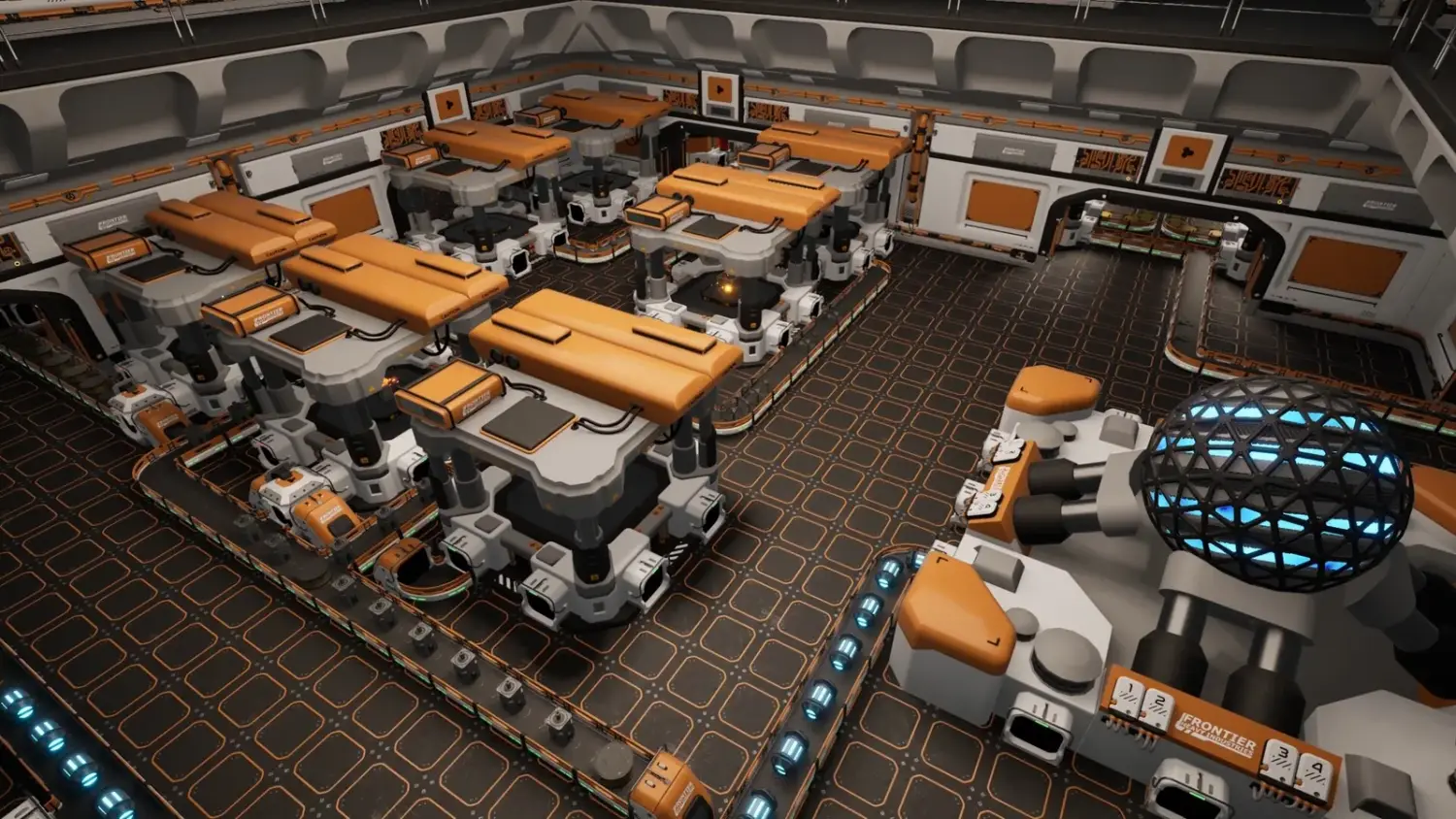
Refinery cycles are 3 seconds and assemblers are 2 or 6; match belts to those rates before adding machines.
The refinery: plates and glass
The refinery runs a 3-second cycle and outputs 20 units per minute for most recipes.
| Recipe | Input | Output | Rate |
|---|---|---|---|
| Nickel plates | 1 Nickel Ore | 1 Nickel Plate | 20/min |
| Titanium plates | 1 Titanium Ore | 1 Titanium Plate | 20/min |
| Cobalt plates | 1 Cobalt Ore | 1 Cobalt Plate | 20/min |
| Silicon wafers | 1 Silica | 1 Silicon Wafer | 20/min |
| Reinforced glass | 2 Silica | 1 Reinforced Glass | 20/min |
| Hydrogen fuel | 2 Water Ice | 1 Hydrogen Fuel | 10/min (6s cycle) |
Two things stand out. First, reinforced glass consumes twice the silica for the same output, so a glass line needs two silica refineries to keep one glass refinery fed. Second, hydrogen fuel runs at half speed; a reactor station needs a dedicated ice supply, not a spare refinery.
The assembler: components
The basic assembler runs a 2-second cycle for simple components and a 6-second cycle for circuits.
| Recipe | Input | Output | Rate |
|---|---|---|---|
| Magnetic Coils | 1 Nickel Plate | 1 Magnetic Coil | 30/min |
| Lightweight Frames | 1 Titanium Plate | 1 Lightweight Frame | 30/min |
| Basic Circuits | 2 Silicon Wafers + 2 Magnetic Coils | 1 Basic Circuit | 10/min |
| Capacitors | 2 Nickel Plates + 1 Titanium Plate | 1 Capacitor | 15/min |
The nickel bottleneck appears immediately. One coil assembler consumes 30 nickel plates per minute, which is 1.5 nickel refineries. A basic-circuit assembler consumes 20 coils and 20 wafers per minute, which is two-thirds of a coil assembler and one full silica refinery. A capacitor assembler consumes 30 nickel plates and 15 titanium plates per minute, which is 1.5 nickel refineries and 0.75 titanium refineries.
If you build one refinery, one coil assembler, and one circuit assembler, the circuit assembler will run at roughly half rate because the refinery cannot feed the coil line. That is the most common early “why is research so slow” problem.
A balanced first block
A compact block that feeds itself:
- 2 nickel refineries (40 plates/min).
- 1 titanium refinery (20 plates/min).
- 1 coil assembler (30 coils/min, consumes 30 plates).
- 1 frame assembler (30 frames/min, consumes 20 plates — slightly starved).
- 1 silica refinery (20 wafers/min).
- 1 circuit assembler (10 circuits/min, consumes 20 wafers + 20 coils).
The frame assembler is intentionally underfed; frames are needed in bursts for station modules, not continuously. If you need a steady frame supply, add a third titanium refinery. Do not add a second frame assembler until you have the plates for it.
Power for this block: two refineries at 4.5 MW, four more at 4.5 MW equivalent, two assemblers at 6 MW, and a circuit assembler at 6 MW. That is roughly 45 MW, which is four solar panels or one reactor. This is the point where the station stops being a starter.

Advanced production
The advanced assembler runs a 12-second cycle and outputs 5 units per minute. Its recipes are where the factory becomes a supply chain rather than a set of independent machines.
| Recipe | Input per cycle | Output | Rate |
|---|---|---|---|
| Advanced Circuits | 3 Detector Array + 3 Basic Circuits + 1 Superalloy + 6 Coolant | 1 Advanced Circuit | 5/min |
| Advanced Plate | 6 Chromatic Alloy + 6 Chitin Composite + 2 Reinforced Plate + 1 Multisensor | 1 Advanced Plate | 5/min |
At 5 per minute, an advanced assembler consumes 15 detector arrays, 15 basic circuits, 5 superalloy, and 30 coolant per minute. That is a lot of upstream lines for a small output. Build advanced production only after the basic circuit line is stable, and buffer the inputs in dedicated containers so a single missing component does not stop the whole block.
The Enrichment Chamber runs a 6-second cycle and outputs 10 per minute:
| Recipe | Input | Output | Rate |
|---|---|---|---|
| Chromatic Alloy | 6 Iridium Plates + 3 Superalloy | 1 Chromatic Alloy | 10/min |
That is 60 iridium plates and 30 superalloy per minute. Iridium is a later-game ore; do not build the chamber until you have a route to it.
Science production
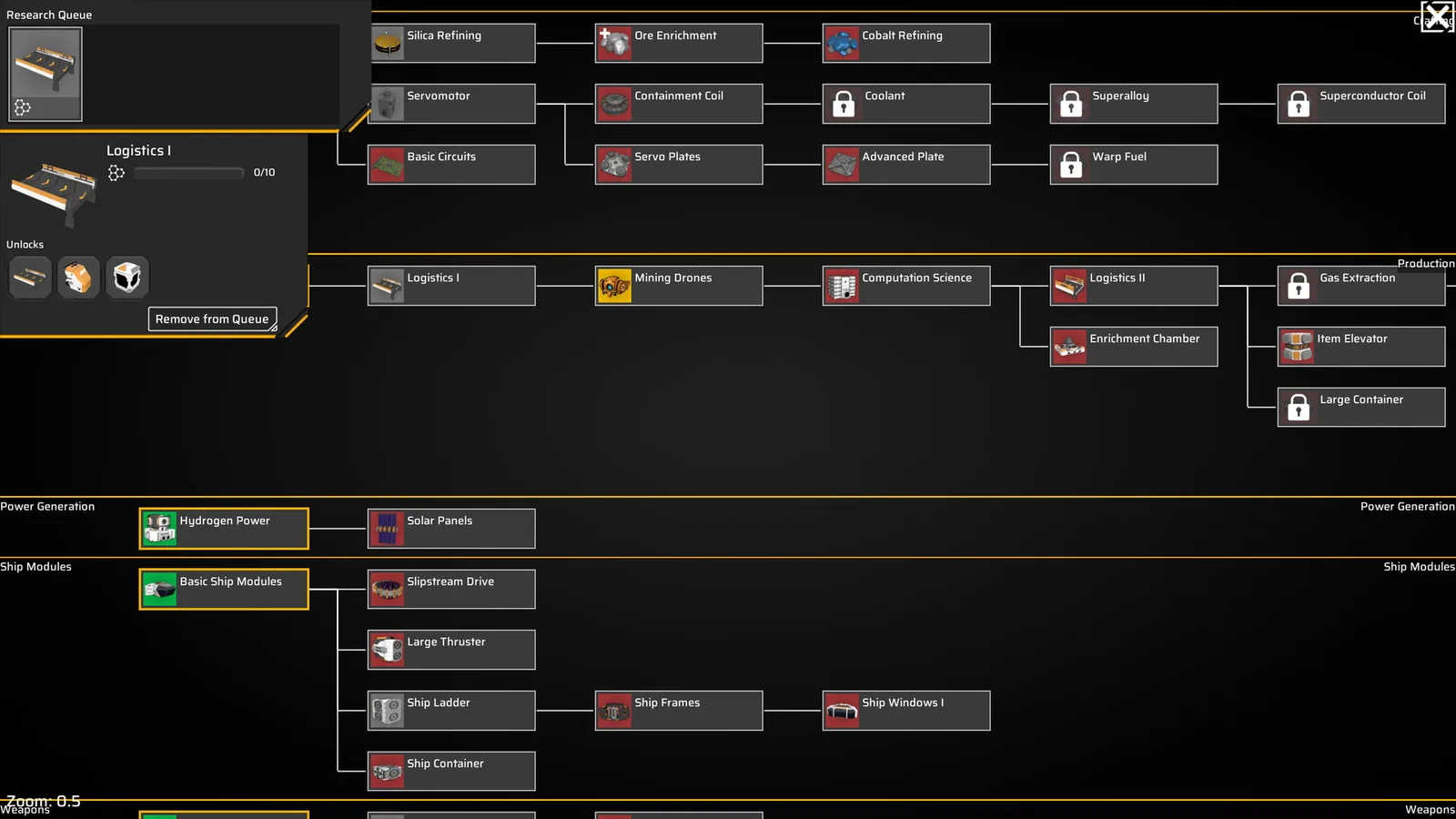
Research labs consume science items, and the tech tree costs are expressed in Material, Computation, Electromagnetic, and later science types. The production chain is therefore:
- Refineries and assemblers make the item the lab consumes.
- Labs convert the item into research progress.
- The tech tree spends that progress on unlocks.
The practical rule is to keep one container per science type between production and the lab. A lab that pulls directly from a shared belt will starve whenever the belt switches recipes. A container buffer smooths the spikes and makes the shortage visible.
Do not build a second lab before you can feed the first one. A lab at 12 MW drawing idle power is worse than no lab, because it hides the real bottleneck.
Reading the ratios in-game
The machine tooltip gives cycle time and output per minute. To check a chain, multiply output rate by the input quantity per cycle:
- Coils: 30/min × 1 nickel plate = 30 plates/min.
- Circuits: 10/min × 2 wafers = 20 wafers/min.
- Capacitors: 15/min × 2 nickel plates = 30 nickel plates/min.
Then compare to the upstream machine's output. If the upstream output is lower, the downstream machine is starved; if higher, the upstream machine backs up. The fix is always a machine count change or a buffer, never “wait longer.”
Buffers: how much is enough
A buffer container between two machines should hold two to three minutes of production. For a circuit assembler at 10/min, that is 20–30 circuits. For a refinery at 20/min, 40–60 plates. More than that hides problems; less than that transmits every hiccup.
Use separate containers for each item. A mixed container makes the belt filter ambiguous and the shortage invisible.
If the chain keeps stalling, the power guide→ is the usual culprit.
FAQ
How many refineries feed one coil assembler? One and a half. Build two refineries or accept intermittent coil production.
How many silica refineries feed a circuit assembler? One, because the assembler consumes 20 wafers per minute and a refinery makes 20.
Why is my circuit assembler slow? It is almost always coil starvation. Check the nickel refinery count before adding circuits.
How fast is hydrogen fuel? 10 per minute, with a 6-second cycle and 2 water ice per unit.
Can I run advanced production in the demo? Advanced assembler recipes exist, but the demo locks the higher tiers needed to sustain them. Treat them as launch planning.
Official source: Main Sequence on Steam ↗ and the Steam news hub ↗.
Sources
- Main Sequence on Steam ↗ — production and factory description.
- Steam news: Next Fest demo update ↗ — demo economy changes.
- Main Sequence on SteamDB ↗ — build 26097974 reference.
- Mythwright ↗ — publisher.